IGNOU Celebrates 41st Foundation Day,
Highlights Vision for Inclusive and Technology-Enabled Education
The Indira Gandhi National Open University (IGNOU) celebrated its 41st Foundation Day on 19 November 2026 at the IGNOU Headquarters in New Delhi, reaffirming its commitment to expanding access to quality, equitable and relevant higher education through Open and Distance Learning (ODL). Dr. Tim Curtis, Director and Representative, UNESCO Regional Office for South Asia, graced the occasion as the Chief Guest, while Prof. Uma Kanjilal, Vice Chancellor, IGNOU, presided over the programme. The celebration brought together senior University officials, faculty members, staff, learners and distinguished guests to reflect on IGNOU’s journey and its contribution to democratizing higher education.
Prof. Jitendra Kumar Srivastava, Registrar, IGNOU, welcomed the Chief Guest and other distinguished guests. In his address, he reflected on IGNOU’s remarkable journey from its inception to becoming one of the world’s largest open universities, serving nearly four million learners across the country and beyond through its extensive academic and learner-support network.
Delivering the presidential address, Prof. Uma Kanjilal, Vice Chancellor, IGNOU, extended her greetings on the occasion of the University’s 41st Foundation Day and reflected on IGNOU’s founding vision and its role in making quality education accessible to diverse sections of society. Reiterating the University’s commitment to quality, equity and relevance, Prof. Kanjilal emphasized the need to ensure that institutional policies, academic processes and technological interventions translate into tangible benefits for learners. Underscoring this approach, she remarked, “Every policy, platform and process must therefore pass one test. Does this make it easier for our learners to progress? That is what quality, equity and relevance mean in practice.”
Highlighting the University’s continued expansion, Prof. Kanjilal informed that IGNOU recorded 5.37 lakh fresh enrolments in the July 2026 admission cycle. During the same session, the University dispatched 6.5 million units of self-learning materials, while nearly 1.85 lakh distance learners opted for digital copies. Together with online learners, they accounted for just over one-third of fresh admissions. Dwelling on the University’s digital transformation, the Hon’ble Vice Chancellor highlighted the integration of the Online Programme Management System (OPMS) and Online Assignment Management System (OAMS) with SAMARTH to streamline assignment submission, allocation, evaluation and record management. Emphasising the transformative potential of Artificial Intelligence (AI) in education, Prof. Kanjilal outlined IGNOU’s vision of evolving into an Agentic University. The Hon’ble Vice Chancellor referred to the University’s collaboration with IIT Bombay for developing multilingual learning resources and its exploration of AI-powered platforms. She also stressed the importance of linking academic learning with practical competencies and professional skills, citing IGNOU’s collaborations with NCVET and CII. Another significant initiative highlighted during her address was IGNOU’s collaboration with the Revenue Department, Government of Gujarat, and the Sardar Patel Institute of Public Administration (SPIPA), Ahmedabad, for developing learning and capacity-building programmes in disaster management.
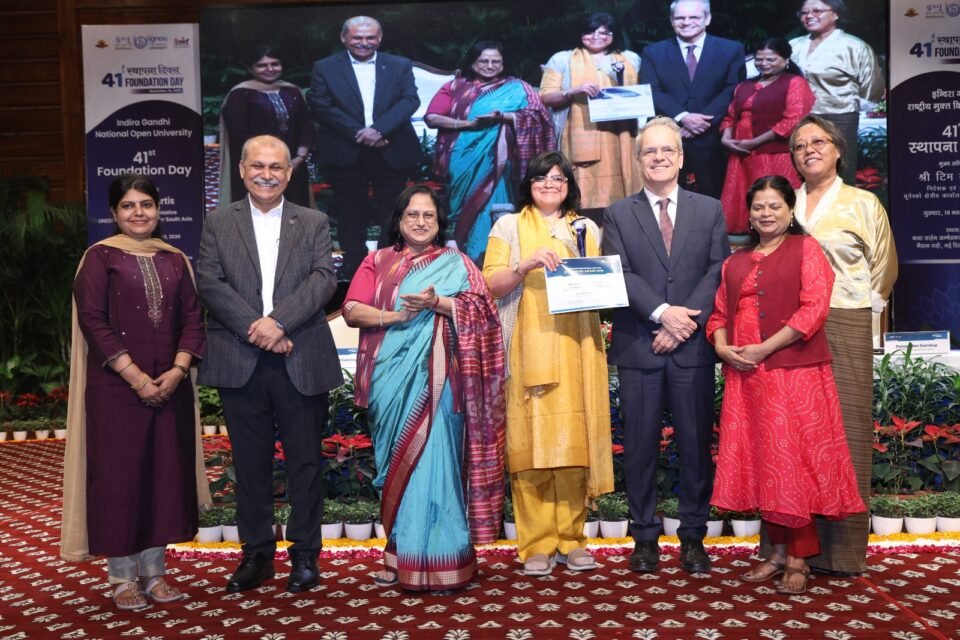
The celebrations also featured presentations by ‘Poshtika’ and ‘SmartOff’, the two IGNOU student teams that won second and third positions at the DS2S International Hackathon. Their demonstrations highlighted learner-led innovation and the application of technology to address real-world challenges. Awards were also presented in recognition of achievements and contributions across various areas of the University’s activities. A major highlight of the occasion was the launch of the Ecology, Environment and Sustainable Development module under the Disaster Management Initiative, developed in association with the Department of Revenue, Government of Gujarat, and SPIPA, Ahmedabad. A recorded message by Dr. Jayanti S. Ravi, Additional Chief Secretary, Revenue Department, Govt. of Gujarat was screened during the programme. Commending IGNOU’s contribution to education and capacity building, she appreciated the University’s support in developing micro-credential courses for the Department and highlighted their potential to strengthen professional knowledge and competencies. Awards for excellence in academics, research and administrative performances were presented to Faculty, Students, Schools, Regionals Centres, Divisions, Cells & Units by the Chief Guest and the Vice Chancellor.
Addressing the gathering as Chief Guest, Dr. Tim Curtis congratulated IGNOU on completing 41 years and commended its contribution to expanding educational opportunities across India and beyond. Referring to the University’s reach of nearly 3.9 million learners through its nationwide network and presence in 88 countries, he observed that these figures represented not merely institutional scale but the opportunities extended to people who might otherwise remain excluded from higher education. Highlighting the significance of Open and Distance Learning in a diverse country such as India, Dr. Curtis noted that geographical constraints, income disparities, gender, language and unequal access to technology continued to influence educational opportunities. Referring to UNESCO’s Global Trends in Higher Education report published in 2026, Dr. Curtis drew attention to the growth in global higher education enrolment as well as the continuing challenge of student dropouts and incomplete qualifications. Dr. Curtis also highlighted the growing importance of lifelong learning, reskilling and the recognition of prior learning. Acknowledging the increasing participation of women in higher education, he also emphasised the need to strengthen women’s representation in senior academic leadership.
Turning to the changing educational landscape, he discussed the opportunities and challenges associated with Artificial Intelligence. Referring to UNESCO’s Recommendation on the Ethics of Artificial Intelligence, Dr. Curtis underlined the importance of human rights, transparency, accountability and human oversight in the deployment of AI. He maintained that artificial intelligence should complement human learning and judgement rather than replace them, and stressed the need to equip learners with the ability to critically evaluate AI-generated information. Dr. Curtis further highlighted the importance of Media and Information Literacy (MIL) in enabling learners to distinguish credible information from misinformation and navigate increasingly complex digital environments. Referring to UNESCO’s collaboration with IGNOU and the South Asia Centre for Teacher Development in Sri Lanka, he spoke about adapting UNESCO’s global MIL curriculum to the South Asian context.
The programme concluded with a vote of thanks by Prof. Pema Eden Samdup, Director, International Division. Reflecting on the ideals underpinning the University’s establishment, Prof. Pema emphasised its responsibility to ensure that educational opportunities remained accessible irrespective of geographical, social or economic barriers. The 41st Foundation Day celebration provided an occasion to reflect on IGNOU’s evolution and its continuing responsibility to democratise higher education. As the University moves forward, its emphasis on learner-centric policies, technological innovation, lifelong learning and inclusive educational opportunities remains central to its founding vision of making quality higher education accessible to all.
Public Information Unit (PIU),
Indira Gandhi National Open University,
Maidan Garhi, New Delhi – 110068.