Written by ….9911853902….Matiur Rehman Aziz
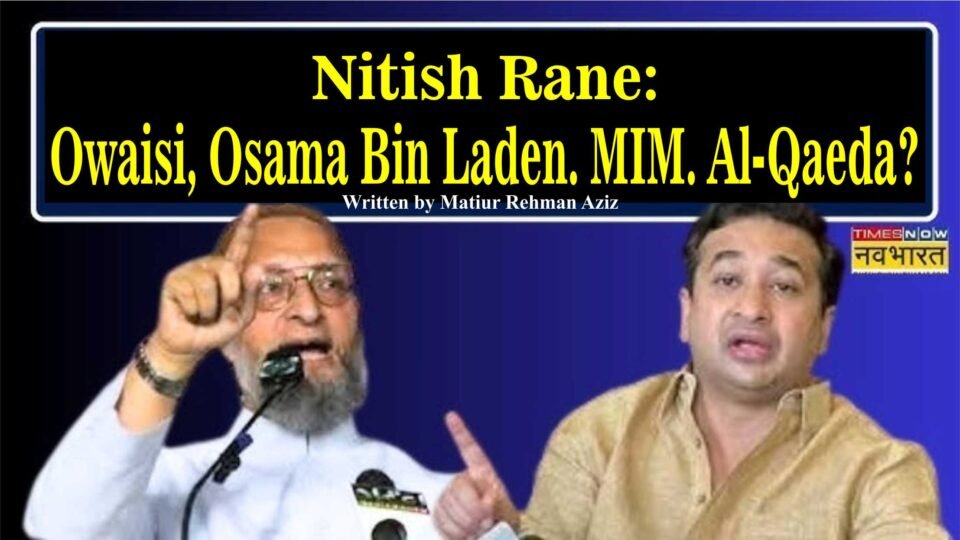
Maharashtra minister and BJP leader Nitish Rane has recently come out strongly against the All India Majlis-e-Ittehadul Muslimeen (AIMIM) and its president Asaduddin Owaisi. He has termed the AIMIM a "terrorist organisation”, compared Owaisi to Osama Bin Laden, and demanded that it be banned like the PFI. This statement came in the wake of the Nashik TCS case or Owaisi’s "hijab wali PM” statement, which created a stir in political circles. From my point of view, this statement by Nitish Rane is not surprising but an example of foresight. Nitish Rane did not vent his anger in the form of mob lynching of innocent Muslims, but responded on a political and ideological level. And the fact is that in the opinion of many people, Owaisi and AIMIM are even more dangerous than what Nitish Rane said. Let us examine this in detail.
Nitish Rane said that “AIMIM is a terrorist organisation”. There is no difference between Osama Bin Laden and Asaduddin Owaisi. What Bin Laden used to do through Al Qaeda, Owaisi is doing through AIMIM. Owaisi and AIMIM’s manifesto has only one agenda “al-Gawad and separatism”. He also questioned the work of AIMIM in the elected constituencies and demanded a ban. This statement is not an empty provocation, but is based on several incidents. AIMIM’s history is linked to (the Volunteer Party), which was a symbol of Muslim supremacy and separatism in Hyderabad in the 1940s. Even after independence, its politics has been run on communal lines. The Owaisi family’s speeches often include words like "Muslim identity”, "separatism”, and criticism of calling India a "Hindu Rashtra”. Owaisi’s recent statement that "a daughter wearing a hijab will become the Prime Minister” has raised concerns among many Indians, as it hints at a specific agenda in the name of secularism.
Nitish Rane’s statement comes as no surprise to those who closely follow Indian politics and social reality. The AIMIM often polarises votes in elections. Its presence in Maharashtra, Telangana and other states exacerbates the Hindu-Muslim divide. The BJP and other parties call it part of "fake secular or sham secular” politics that targets only the Muslim vote bank. Although the AIMIM calls itself a secular and Muslim-friendly party, its speeches, posters and statements by some leaders smack of Islamic supremacist or separatist thinking. Allegations of involvement of AIMIM corporator in cases like Nashik Maharashtra have further exposed him to criticism.
Nitish Rane’s question is justified that where AIMIM was elected, what notable work was done in sectors like education, health, employment? Instead, politics was being run on religious slogans, Palestine, hijab and anti-Hindu narrative. He rightly said that usually "vile and cowardly” people in anger resort to mob lynching or violence against innocent Muslims, which is condemnable. Nitish Rane responded to this on the contrary at the political level. This is far-sighted because it is a challenge within the ambit of law and democracy. It awakens the people that vote bank politics is damaging the unity of the country. India is a Hindu majority country (about 80-85% population), but it is for everyone. One-sided secularism that only imposes restrictions on the majority is not acceptable.
If the AIMIM were truly progressive, it would have focused on modern education, skills, and mainstreaming Muslim youth, rather than on a persistent narrative of oppression and separatism. Are Owaisi and the AIMIM even more outdated? According to many analysts and the general public, yes. Owaisi’s speeches often have a distinctly anti-Hindu angle on Indian civilization, history (praising Aurangzeb, etc.) and interpretation of the Constitution. The “hijab wali PM” remark was seen by many as a reference to demographic change and the dream of an Islamic state.
The AIMIM talks about “Muslim unity” against the BJP, but in practice, it has taken advantage of vote-sharing or division in some cases. Where other Muslim leaders (like some Congress or regional parties) talk about development, Owaisi’s focus is mostly on religious identity and grievances. This could lead the younger generation towards extremist tendencies. Although not proven, the AIMIM’s proximity to Palestinian, anti-Israel and global Islamist narratives fuels the allegations.
Nitish Rane’s statement is a voice that speaks to the hearts of many silent Indians. India is a secular country, but that does not mean that the culture, sentiments and concerns of the majority should be ignored. If parties like AIMIM want to be progressive, they will have to change their narrative, emphasizing education instead of separatism, national unity instead of unity, and self-accountability instead of victimization. What Nitish Rane said is not a statement of anger but of reality. And as it is said, Owaisi and AIMIM are something beyond that. In political debate,