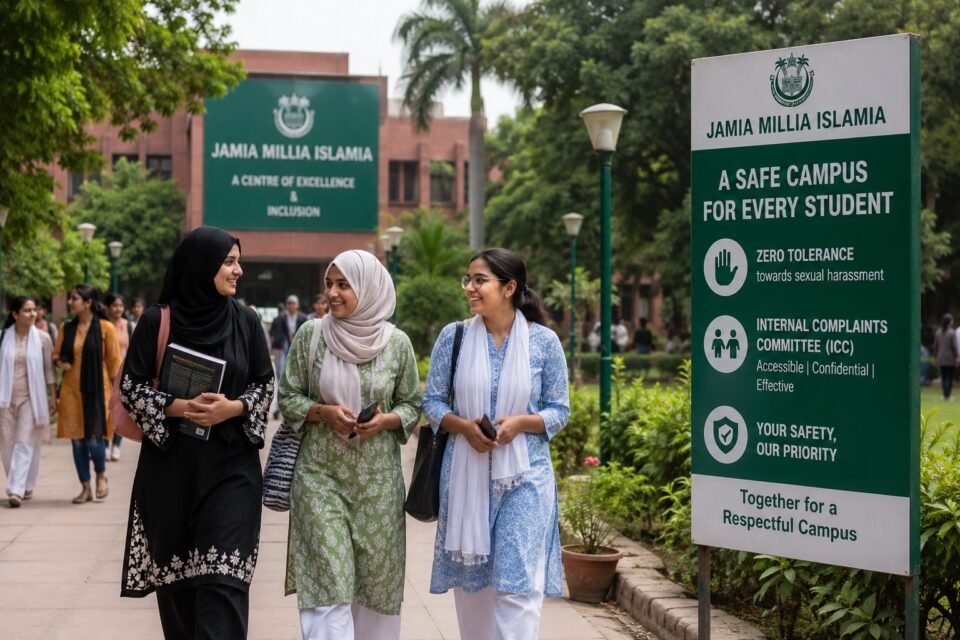
Jamia Millia Islamia: The Home Where We Are Safe
Dr. Afsana Islam
Research Scholar, Jamia Millia Islamia, New Delhi
Fifteen days ago, I submitted my PhD thesis. A journey of over a decade—in one university, in the same hostel, in the same city. On the day I submitted that file, my eyes were filled with tears—of joy, of pride, and of gratitude toward this institution that has nurtured me, educated me, and kept me safe.
Then—that very week—I read an article in the Indian Express attempting to portray Jamia as an institution plagued by sexual harassment. I read it twice: once in anger, and once wondering if I had misunderstood. But no, it was saying exactly what I had read the first time. That is when I decided I could not remain silent. Because the Jamia I have seen, the one I have felt, the one I have lived in—it is my right and my duty to tell that story. Under the guidance of Professor Mazhar Asif, Jamia’s "zero-tolerance” policy is not only correct; it should be a model for every modern educational institution.
I began my higher education journey at Jamia Millia Islamia with my Bachelor’s degree, completed my Master’s, and recently submitted my PhD thesis. Over this decade-long experience, I have had the privilege of closely observing the university’s environment, classrooms, libraries, hostels, and the daily lives of students. As a student, a researcher, and a ten-year companion of Jamia’s journey, I feel compelled to ensure that Jamia Millia Islamia is seen in its true light. I have witnessed Jamia under several Vice-Chancellors. And I say with responsibility that the current administration—under the leadership of Professor Mazhar Asif and Professor Mohtab Alam Rizvi—has taken measures for the protection of women students that I have never seen before. This is not my opinion; it is my observation. This is an institution that, rather than hiding its problems, attempts to confront them. Here, women’s safety is taken seriously, and transparency is adopted as institutional strength.
The New Indian Express reported "24 complaints in Jamia over three years” and left it at that. A headline, a story, done. But pause for a moment and think: when does a student file a complaint? When she is confident that she will be heard. When she is not afraid of being blamed. When she knows the system is with her, not against her. In my ten years, I have seen institutions where no complaints ever come in—not because nothing happens, but because students know that filing a complaint is futile. There is silence there, but it is the silence of helplessness, not peace. When Jamia receives complaints, it means students have trust. They know that the ICC’s door is open, phone numbers are available, online portals are accessible, and most importantly, action will be taken. An institution with no complaints does not necessarily mean all is well. It may simply mean students lack the courage to speak up. Complaints being filed is not the system’s failure; it is students’ courage and the system’s success in building confidence.
Let us first understand the facts. Jamia Millia Islamia has more than 22,000 registered students. In 2025, there have been 11 complaints, and it is crucial to note that all have been completed with immediate action on each. Now consider JNU, which has only 8,800 to 9,000 students but has recorded 26 complaints. In per-capita terms, Jamia’s rate is significantly lower than JNU’s. Yet the Indian Express’s negative headline is about Jamia, not JNU. This is not fair. It makes one wonder about the intent behind such bias. I leave this question hanging—let readers draw their own conclusions.
I am not speaking from administrative documents or official statements. I am sharing what I have seen, felt, and lived through over my ten years here. Since this administration took charge, the standard of security on campus has completely transformed. No unrelated person can enter the campus now. There has been a marked increase in CCTV cameras. Night patrols are conducted regularly. When Professor Mazhar Asif and Registrar Professor Mohtab Alam Rizvi took on their responsibilities, they created a clear, logical, and practical plan for student safety and welfare. Most significantly—when an incident occurred, the Vice-Chancellor himself came to campus at night. He came personally—did not send a representative or issue a statement—he came to verify that students were safe. This seems like a small thing, but for a girl living in a hostel, it conveys a powerful message: our leadership considers us important not just on paper, but in practice.
In all my years at Jamia, I have not seen any administration better than this one. They have issued clear directives, conducted multiple awareness campaigns, held seminars against sexual harassment, and most importantly, made the Internal Complaints Committee (ICC) more active and accessible. Students can now file complaints via phone, email, online portals, and in person. Complainants are assured of identity protection and confidentiality, and investigations are completed within prescribed timelines.
The university’s prevention education and awareness strategy is also very robust. Different faculties and departments are required to regularly conduct seminars on sexual awareness, street plays, and awareness drives. None of these are mere formalities. Each seminar educates students about acceptable boundaries. The Sarvepalli Radhakrishnan Centre for Women’s Studies (SNCWS) works on advocacy, research, and improvement of women’s issues. This center conducts workshops on women’s rights, combating online harassment, and protection from sexual violence. Jamia also has psychological support and counseling facilities, which are vital for students experiencing any form of mental stress or harassment. In modern educational institutions, mere complaint registration is not considered sufficient; the psychological recovery of the affected person is given equal importance, and Jamia is making progress in this direction as well.
Under the leadership of Vice-Chancellor Professor Mazhar Asif and Registrar Professor Mohtab Alam Rizvi, Jamia has not only advanced in academic rankings, research activities, and international recognition over the past eighteen months, but has also made efforts to create a safer and more accountable campus culture. It would be an exaggeration to claim that all problems have been completely solved. No university in the world can make that claim. But it can certainly be said that regarding the seriousness with which problems are addressed, the speed of institutional response, and transparency, Jamia has taken a positive direction.
Before writing this piece, I spoke with at least 200 women students from Jamia. Each expressed satisfaction with Professor Mazhar Asif’s leadership. All said that the measures taken by this administration for the protection and safety of women students are very effective and real. All students said they now feel much safer and have never experienced any fear or serious problem. I am including direct testimonies from three students from different departments. To protect their identities, I have changed their names.
Ayesha, a Master’s student in the Department of Education, said: "I can say with confidence that everything needed for my protection exists in this university. I have seen with my own eyes all the security measures the Vice-Chancellor and Registrar have implemented. Cameras are everywhere, security is strict, and if any problem arises, the ICC is always available to help. I even tell my mother that I am completely safe here at Jamia.”
Zainab, a student from the Science Faculty, noted that she has seen different phases of Jamia and has observed significant improvement in the complaint resolution system under the current administration. According to her, students now have the confidence that if they report a problem, the administration will take it seriously.
Umm Hani, a research scholar in the humanities, emphasized: "This administration has brought real change. Perhaps before, some things remained hidden or got lost. Now everything is transparent. Every complaint is heard. Every matter is handled with care. I am encouraging my sister to get admitted to Jamia because I am confident she will be completely safe here.”
It is easy to dismiss these accounts as merely emotional statements, but behind them lie the everyday experiences that present any institution’s true picture. Jamia Millia Islamia has not only taken administrative measures for women’s safety but has also done remarkable work in awareness and training. Different departments regularly conduct seminars, workshops, awareness campaigns, and dialogue sessions. The purpose of these programs is not merely to raise awareness about rules but to create an environment where mutual respect, responsibility, and sensitivity flourish.
I am not praising anyone here—I am sharing what I have observed. The changes that have come to Jamia since Professor Mazhar Asif and Professor Mohtab Alam Rizvi’s arrival are noteworthy. I know some will call this piece ‘propaganda,’ say it is defending the institution. But I wonder: when a PhD scholar who has lived in this hostel for ten years, who has journeyed from childhood to adulthood within this institution, who knows every street, every tree, every room of this place—when she says ‘this place is safe’—what weight should her words carry? Should it not carry more weight than someone sitting outside, arranging statistics in a particular way to write an article? I say: Jamia Millia Islamia is my home. In this home, I have never been afraid. In this home, I have studied, learned, grown, and become a doctor. This home’s doors are open to every student who wishes to study, and this home’s walls protect every student who lives here. This is my testimony. This is my ten-year experience. And this cannot be refuted by a newspaper headline.
Jamia Millia Islamia is becoming a shining example of women’s protection in India.